
「Leading Lady」 Noble Leaves the Stage, Is the Cosmos Ecosystem Now a 「Hollowed Shell」?


Original Title: "Noble Leads the Way Out, Another Solid Confirmation of 'Cosmos Is Dead'?"
Original Author: Sanqing, Foresight News
On January 20, Cosmos application chain Noble, focused on stablecoins, announced that it would migrate from the Cosmos ecosystem to an independent EVM L1 network. The Noble EVM is scheduled to launch on March 18, and the team will continue to support Cosmos-based blockchains in the short term. After the migration, Noble's own USDN stablecoin will become a core feature of the EVM L1, with the NOBLE token serving as a governance asset, closely tied to protocol decisions and the usage of stablecoins across the entire network.
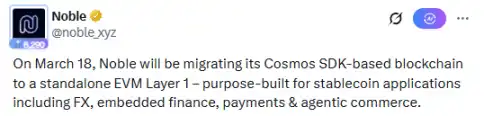
Image Source: Noble Twitter
Subsequently, the founder of Cosmos responded in a post, stating that Noble's transition is not a deviation from the vision of Cosmos, but rather an embodiment of the core concept of "sovereignty and interoperability." Noble's migration does not mean a disconnect from the Cosmos Hub. Instead, through the IBC v2 protocol, the migrated Noble EVM will become a key bridge connecting the EVM ecosystem with the Cosmos economy. He stated, "We are entering an era not defined by chains, but by liquidity."
Cosmos's Stablecoin Ace, Why Choose to Exit?
Noble is one of the most successful stablecoin infrastructure projects in the Cosmos ecosystem. It is the chain that natively issued Circle's USDC to the Cosmos ecosystem, distributing USDC securely and frictionlessly to 50+ chains through IBC, processing over $22 billion in transaction volume to date.
Noble's presence has given the Cosmos ecosystem a competitive edge with a "native stablecoin" and has avoided reliance on trust risks from external bridges.
But why did Noble choose to migrate? The reason given by the Noble team is very practical:
The EVM ecosystem is overwhelmingly dominant. Over 75% of the stablecoin market is on EVM chains. Developers, tools, wallets, dApps are all concentrated on EVM, and since Noble aims to be the "L1 stablecoin infrastructure," it naturally has to follow the money and people.
The EVM technology stack is more developer-friendly. The EVM has a mature toolset including Solidity, Remix, Hardhat, etc., making it easier to integrate protocols like Uniswap, Aave. Although the Cosmos SDK is powerful, it has a steep learning curve, and its ecosystem tools are relatively behind.
The EVM has better performance and real-world use cases. Noble EVM aims for sub-second latency, targeting scenarios such as payments, embedded finance, agentic commerce, FX, etc. While Cosmos' Tendermint consensus is reliable, the EVM stack can better align with mainstream payment chains.
Noble has its own strategic ambitions. Noble doesn't want to be just a "workhorse" within Cosmos but aims to become an independent high-performance stablecoin Layer 1, directly competing with other stablecoin public chain projects.
Therefore, Noble voted with its feet. Cosmos provided the initial groundwork, but the EVM offers it a scalable future.
Noble's Departure Took Away Cosmos's "Half-Life"
Noble is Cosmos's only "super giant." Noble's 30-day IBC transaction volume reached USD 93.84 million, which is 1.8 times that of the second-ranking Osmosis (USD 50.06 million). Within the 110 Zones linked by Cosmos IBC, Noble contributed at a ruptive level of liquidity.
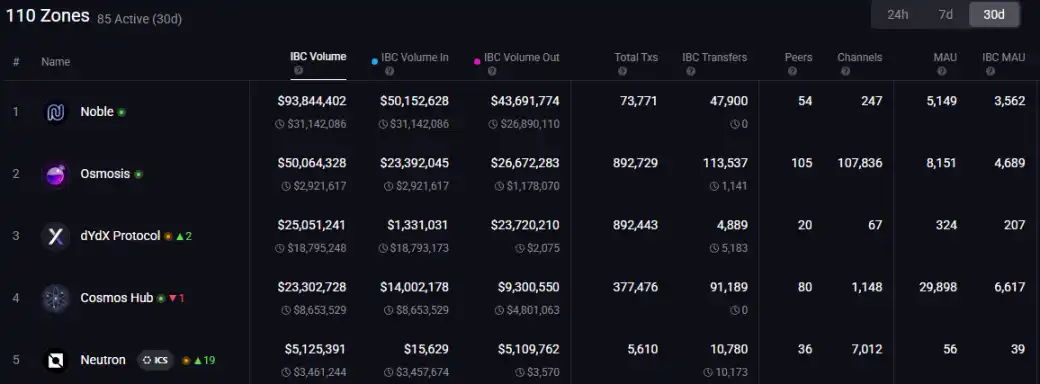
Image Source: MAP OF ZONES
Noble is the "faucet" for institutional funds. Osmosis has nearly 900,000 transactions, while Noble has only 73,000. This means that Noble's single transaction value is much higher compared to other chains. It handles institutional-level stablecoin settlements and large-scale distributions, not retail-level small exchanges.
Although there are 110 linked Zones through IBC, only 85 are active. This indicates that 23% of the chains are already in a state of death. Liquidity is highly concentrated in the top four chains, while projects outside the top ten have seen their monthly transaction volumes shrink to the million-dollar level, and the ecosystem's retail vitality is severely overdrawn.
The Cosmos Hub has approximately 30,000 monthly active users, which is six times more than Noble (around 5,000 people). However, the money actually flows to Noble. Most Cosmos users mainly stake or observe on the Hub, whereas the stablecoin activities that truly generate value are almost solely dependent on Noble.
The Soul of the Cosmos Ecosystem: How IBC Powers the "Blockchain Internet"
The core narrative of Cosmos is the "Internet of Blockchains" — an internet of blockchains, with IBC (Inter-Blockchain Communication Protocol) being the technology that makes this vision a reality.
IBC is Cosmos's most unique and successful invention. It enables independent sovereign chains to securely and trustlessly communicate and transfer assets to each other, similar to TCP/IP on the internet. Its key features include:
Minimal Trust: Verifying the state of the counterparty chain through light client validation, without the need for asset custody or multi-signature bridges.
Permissionless Interoperability: Anyone can create a channel to support token transfers, Interchain Accounts, Interchain Queries, and more.
Universality: Agnostic to consensus mechanisms, already connected to 110+ chains (Map of Zones data), and expanding to non-Cosmos chains like Ethereum and Optimism.
IBC has demonstrated high security, never experiencing a large-scale exploit, with billions of dollars transferred cumulatively. Despite any controversies in other parts of Cosmos, IBC itself remains a top-tier interoperability solution in the industry.
However, Noble's migration also exposed an awkward aspect of IBC: while it interconnected the world, it couldn't retain projects — as everyone interconnected, they all wanted to dominate as a single chain on the EVM.
Exodus Confirmation: Which Cosmos Projects Have Died or Migrated by 2025-2026?
From 2025 to early 2026, the Cosmos ecosystem experienced a significant "project exodus/closure wave."
First, let's talk about the projects that have completely closed or ceased operations, with most of them having already perished by 2025, leaving only the community's regrets and sporadic maintenance attempts.
The privacy chain Penumbra has shut down completely, with the team exiting. While the chain is being reluctantly maintained by the community, it is mostly ignored, becoming the most typical example of complete closure. Pryzm has also shut down entirely, with Comdex and Kujira falling in succession, the latter even taking down sub-projects like Fusion and Levana, causing a fracture in the entire DeFi ecosystem.
Stride has formally sunsetted, ceasing operations; Quasar and Tower have successively perished, Picasso / Composable trapped users' SOL assets after a crash, leaving users empty-handed. Drop has abandoned its TGE and sunsetted, Milkyway has shut down, Demex failed to recover after a hack, Evmos has also essentially died.
These projects covered multiple tracks such as DEX, lending, privacy, NFTs, among others, mainly due to lackluster growth, insufficient revenue, team attrition, and the long-term aftershocks of Terra's collapse.
Meanwhile, some projects chose to migrate to non-Cosmos stacks or committed the ultimate betrayal to the Cosmos narrative. Except for Noble, Sei had also previously decided to abandon its dual-stack architecture in SIP-3 upgrade, planning to retain only the EVM chain by mid-2026.
Akash is migrating to Solana, while projects like Elys, pStake, Jackal, Omniflix are migrating to Base, Stargaze is forking to an independent chain and planning to migrate to the Cosmos Hub, Shade Protocol (rebranded Feather) first migrated to Sei, with potential further EVM-ization in the future.
The core motivation behind these migrations is almost unanimous: the developer tools, liquidity, and market size of the EVM ecosystem far surpass those of Cosmos; project teams are voting with their feet, choosing to follow the money and opportunities.
There is another group of projects that, while not dead, have entered maintenance mode or resource redirection, with slow project progress.
Osmosis has entered maintenance mode, still maintaining tokenomics and other updates, but with a noticeable outward shift in team resources and a significant drop in activity; Astroport is similar, essentially stagnant; after the Axelar team was acquired by Circle, the original project's influence sharply declined. These projects were once the pillars of Cosmos DeFi but have now become a microcosm of ecosystem contraction.
Mantra has undergone restructuring (January 2026 layoffs, cost optimization) and the OM token crash (nearly 99% drop), but the project is still advancing. The ERC-20 OM migration is underway, with RWA vaults, launchpad, and other features in development, and there will continue to be operations of an IBC-compatible RWA EVM L1.
Furthermore, a large number of DEXs such as Wynd, Hopers, Junoswap, Loop, TerraSwap, among others, closed in 2024-2025. Retail DeFi is basically cooling off, with only institutions and RWAs holding the fort.
The MAP OF ZONES shows IBC connecting 110 chains, but IBC traffic is heavily concentrated in the top few (Noble, Osmosis, Cosmos Hub), and once Noble's liquidity moves away, the entire ecosystem's vitality will be further diminished.
Although the Cosmos 2026 roadmap attempts to reverse the decline through EVM compatibility and high-performance upgrades, Noble's "walkout" undoubtedly reveals a harsh reality: in the face of liquidity, the technological narrative often appears feeble and inadequate.
Original Article Link
You may also like

Cryptocurrency CEXs are flocking to sell US stocks, and traditional brokerages are facing an "uninvited guest."

Will the SpaceX IPO Hurt Bitcoin? Here's What Traders Are Watching
Foreign selling in the South Korean stock market accelerates, with cumulative net sales reportedly reaching $75 billion this year
On June 9, The Kobeissi Letter, citing Goldman Sachs data, reported that global investors are selling South Korean stocks at an unusually rapid pace. In the latest trading session, foreign investors sold about $801 million worth of Kospi constituent stocks again; total foreign outflows last week reached about $10 billion, and the market has been in net foreign selling on nearly every trading day over the past month. According to the data cited in the report, foreign investors have sold about $75 billion worth of South Korean stocks so far this year. Meanwhile, South Korean retail and institutional investors together recorded roughly $69 billion in net buying over the same period, suggesting that the market’s main buying support has come from domestic capital rather than returning overseas funds. The information currently disclosed still mainly comes from The Kobeissi Letter’s retelling and Goldman Sachs data summaries, while public details on the statistical period and the specific definition of “selling” remain relatively limited.

Fortune Warns of Strategy’s Financing Structure Risks as Bitcoin Premium Narrows
Fortune warned that Strategy’s Bitcoin treasury model faces growing financing risks as MSTR’s net asset premium narrows and preferred stock dividend pressure increases.

Ferrari Challenge Le Mans: Carl Moon to Dominate in WEEX Livery

Sahara AI Responds to SAHARA’s Sharp Drop: No Contract or Product Security Issues Found, Internal Investigation Underway
Sahara AI responded to SAHARA’s 60% price drop, saying no token contract or product security issues have been found and an internal investigation is underway.

WEEX Deposit/Withdrawal Dynamic Island: Your Asset Status, Always in Sight

Scaling Crypto Derivatives: The Digital Asset Infrastructure Behind High-Volume Trading
In the fast-moving digital asset ecosystem, derivatives platforms face an extreme architectural test. High-leverage futures markets demand more than just standard security—they require absolute operational precision, zero-latency matching engines, and ironclad structural scalability, all while navigating intense market volatility.
As global platforms scale to meet these demands, the industry is shifting away from rigid, monolithic setups toward a more agile, "decoupled" infrastructure philosophy.
The Blueprint for High-Volume Copy TradingFor elite global exchanges like WEEX (founded in 2018), this architectural choice becomes critical when scaling high-volume retail features like social copy trading. When thousands of users automatically mirror the real-time strategies of elite traders simultaneously, it triggers sudden, monumental spikes in concurrent transactional volume.
To prevent execution latency or settlement bottlenecks during these peak volatility events, a platform's primary engine must remain entirely dedicated to risk management, copy-trade synchronization, and order matching.
The Architectural Rule: New-generation platforms must separate front-end user execution engines from heavy backend infrastructural overhead to eliminate operational friction.
By separating these layers, platforms can maintain complete sovereignty over their trading environments and user experiences while strategically aligning with institutional-grade infrastructure ecosystems. This strategic framework allows modern exchanges to leverage advanced Digital Asset Custody infrastructure such as Cobo’s behind the scenes, ensuring that backend wallet management scales elastically alongside trading spikes.
Capitalizing on Market Momentum and 400× LeverageIn a derivatives arena where platforms offer up to 400× leverage on perpetual contracts, capital efficiency and market agility are core business metrics. To capture market momentum, an exchange needs the ability to rapidly expand its asset offerings, supporting everything from legacy crypto assets to sudden, trending altcoins across a massive library of trading pairs.
Adopting a flexible, scalable Wallet-as-a-Service (WaaS) solution such as Cobo’s could completely rewrite the development timeline for high-growth exchanges. Instead of spending months of engineering capital building out custom backend wallet architectures for every new blockchain network, platforms can deploy localized infrastructure in days.
This agility allows platforms to instantly scale their listings to over a thousand trading pairs without compromising security or delaying time-to-market. It mirrors the exact operational advantages seen during high-velocity market events, similar to how advanced wallet infrastructure empowers platforms during sudden asset surges; allowing exchanges to pass that speed and liquidity directly to their global user base.
A Mature Foundation for GrowthThe synergy between trusted infrastructure ecosystems and global trading platforms represents the natural evolution of a maturing crypto market. As WEEX continues to scale its global spot and derivatives offerings for over 6 million users, adopting robust backend paradigms proves that platforms no longer have to compromise between cutting-edge trading velocity and uncompromised structural security.

Morning Report | BitMine increased its holdings by 126,971 ETH last week; trader Eugene announced his exit from the crypto market

Wang Chuan: How can one not feel anxious after the neighbor Old Wang made thirty times profit by investing in storage stocks? (Seven) - A quarter-century cycle

Get Paid to Onboard? Try WEEX’s New Homepage with Rewards for Registration, Deposit & Trade

WEEX Custom Layout: Build Your Perfect Trading Workspace in Seconds

See “Buy Walls” & “Sell Walls” Instantly: WEEX Launches the Depth Chart for Smarter Trades

What Is Quick Trade on WEEX? 2 Ways WEEX Ends Chart-Panel Jumping
Morning News | Five major virtual asset platforms in South Korea have experienced 57 incidents of hacking and system failures in six years; Grayscale submits registration application for Canton ETF

Should we escape the peak? The principle of the tail-end market in the stock market

RootData: May 2026 Cryptocurrency Exchange Transparency Research Report

Founder of Baixing.com: My Experience with Claude Code in Fourteen Points
Cryptocurrency CEXs are flocking to sell US stocks, and traditional brokerages are facing an "uninvited guest."
Will the SpaceX IPO Hurt Bitcoin? Here's What Traders Are Watching
Foreign selling in the South Korean stock market accelerates, with cumulative net sales reportedly reaching $75 billion this year
On June 9, The Kobeissi Letter, citing Goldman Sachs data, reported that global investors are selling South Korean stocks at an unusually rapid pace. In the latest trading session, foreign investors sold about $801 million worth of Kospi constituent stocks again; total foreign outflows last week reached about $10 billion, and the market has been in net foreign selling on nearly every trading day over the past month. According to the data cited in the report, foreign investors have sold about $75 billion worth of South Korean stocks so far this year. Meanwhile, South Korean retail and institutional investors together recorded roughly $69 billion in net buying over the same period, suggesting that the market’s main buying support has come from domestic capital rather than returning overseas funds. The information currently disclosed still mainly comes from The Kobeissi Letter’s retelling and Goldman Sachs data summaries, while public details on the statistical period and the specific definition of “selling” remain relatively limited.
Fortune Warns of Strategy’s Financing Structure Risks as Bitcoin Premium Narrows
Fortune warned that Strategy’s Bitcoin treasury model faces growing financing risks as MSTR’s net asset premium narrows and preferred stock dividend pressure increases.
Ferrari Challenge Le Mans: Carl Moon to Dominate in WEEX Livery
Sahara AI Responds to SAHARA’s Sharp Drop: No Contract or Product Security Issues Found, Internal Investigation Underway
Sahara AI responded to SAHARA’s 60% price drop, saying no token contract or product security issues have been found and an internal investigation is underway.


