
NYSE Plans to Launch 24/7 Stock Tokenization Trading, Is the Moat of the Crypto Market Disappearing?

Original Title: "NYSE Plans to Launch 24/7 Stock Tokenization Trading, Competitors Caught Off Guard"
Original Author: Wenser, Odaily Planet Daily
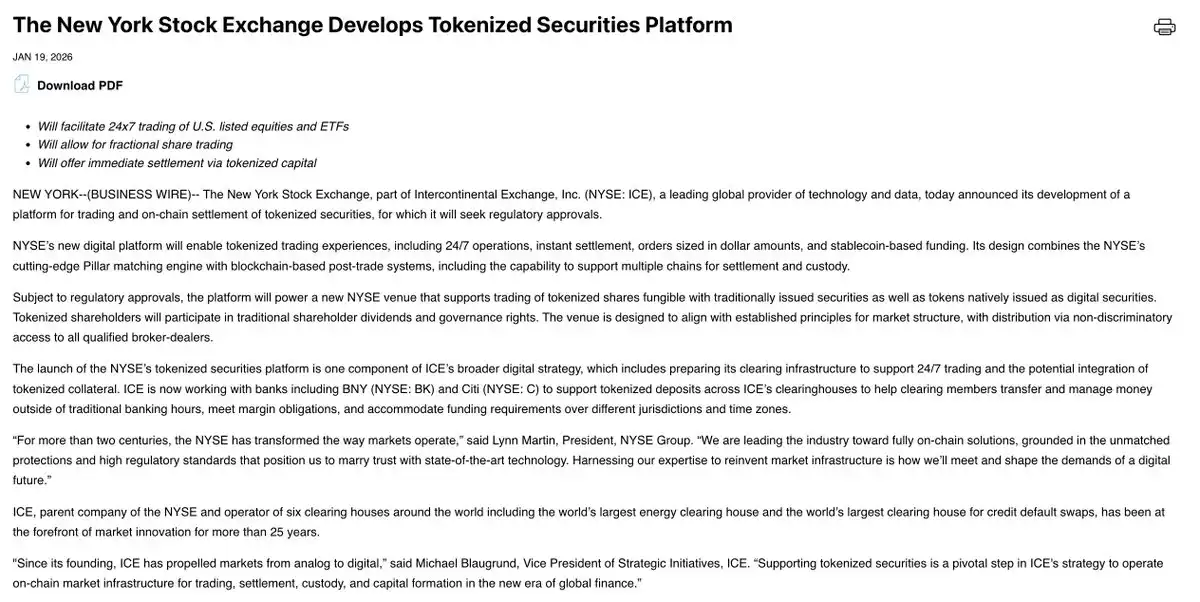
Just as the "Flash Crash Monday" has not yet ended, just now, the crypto market welcomed another heavyweight bombshell — according to multiple media sources, the NYSE plans to launch a tokenized securities trading and on-chain settlement platform that supports 24/7 trading. After investing $2 billion in Polymarket last year, the ICE Group once again, using its securities trading platform as a vehicle, has joined this century's wave of cryptocurrency transformation. It is worth mentioning that as early as September last year, the "rival" Nasdaq had already submitted a tokenized stock trading application to the SEC, and this change by the NYSE is also seen by the outside world as a move to compete with securities trading platforms.
The NYSE Cannot Stay Idle Either: A More Aggressive "Stock On-Chain Tokenization Solution" than Nasdaq
Since Trump took office, the U.S. cryptocurrency regulatory environment has undergone a change, leading to the flourishing development of crypto IPOs, stablecoins, PayFi, and DeFi, sweeping away the policy gloom of the Biden administration period. According to statistics, the stablecoin trading volume reached $33 trillion last year, a 72% year-on-year increase. Behind this is the revenue and profit earned by the two stablecoin issuers, Tether and Circle, representing the immense liquidity that can be directed to the stock securities market.
Moreover, unlike Nasdaq's submission of a tokenized stock trading application to the SEC in September last year, nearly half a year later, the NYSE's "stock tokenization trading" related actions are not just applications to regulatory agencies, but a whole set of "on-chain solutions."
Specifically, the NYSE's "Stock On-Chain Tokenization Solution" includes the following 3 aspects:
1. This is a tokenized securities trading and on-chain settlement platform, planning to support 24/7 trading of U.S. stocks and ETF funds, fractional share trading, stablecoin-based fund settlement, and real-time delivery, and will integrate with the NYSE's existing matching engine and blockchain settlement system.
2. According to the NYSE's plan, tokenized stocks will have the same dividend and governance rights as traditional securities.
3. NYSE's parent company ICE is also collaborating with banking giants such as BNY Mellon and Citi to explore tokenized deposit and clearing infrastructure to support cross-time zone, round-the-clock fund and margin management.
In comparison, if Nasdaq's stock tokenization application seems like a case of "old wine in a new bottle" in response to policy, then NYSE's plan is like a "new retail trading platform" that fully connects all aspects such as "wine making - packaging - distribution - recycling."
Most importantly, NYSE's "stock tokenization" trading platform supports 24/7 trading, which was originally one of the advantages that various cryptocurrencies had over securities stocks. Now, this advantage has become a joke in the face of the massive asset base and liquidity of one of the world's largest stock exchanges, NYSE.
As a result, the crypto market is not without some pessimistic views: "The RWA race in the crypto market and the increasingly tight liquidity will face the harshest 'father.' Compared to NYSE's annual trading volume of over trillions of dollars, crypto RWA projects are almost nonexistent."
Crypto Practitioners' Perspectives: There Are Pros and Cons; the past is the past, the present is the present
In 1792, 24 stockbrokers signed the Buttonwood Agreement under a buttonwood tree outside 68 Wall Street in New York, giving birth to the precursor of NYSE. At that time, limited by the few investment targets and limited market activity, stock trading hours were more flexible, with no strict continuous trading period. Brokers mainly traded through auctions or informally.
On March 8, 1817, the organization officially changed its name to the New York Stock Exchange by drafting a charter.
In May 1887, the NYSE standardized stock trading hours to "Monday to Friday: 10:00 AM to 3:00 PM; Saturday: 10:00 AM to 12:00 PM."
In 1952, Saturday trading was officially discontinued.
In 1985, the stock trading opening time was moved up to 9:30 AM, and the closing time was extended to 4:00 PM, forming the current 9:30 AM–4:00 PM period, which has been in effect for about 41 years.
If NYSE's application for 24/7 tokenized stock trading is approved, it means that the decades or even hundreds of years of "limited trading hour model" will soon become history. From this perspective, the crypto market has gained high recognition from the mainstream financial world.
Pro Viewpoint: The Era Train is Coming
BTC OG and BankToTheFuture founder Simon Dixon posted, stating, "Nothing can stop this train. Tokens are IOUs for custodied real-world assets; they are a supplement to DTCC debt. 24/7 trading is possible without tokens. This is a surveillance state upgrade. You will own nothing and be happy." The post includes an image of BlackRock CEO Larry Fink embracing Coinbase CEO Brian Armstrong.

Crypto KOL from India, Open4profit, posted, saying, "(This will enable) markets to react to global news instantly; AI and algorithms will play a bigger role in pricing and risk management; this is a significant change for the stock market, so closely monitor liquidity changes."
Redstone DeFi co-founder Marcin sees "entrepreneurial opportunity" and states, "This is a good start and aligns with what we are going to do next."
Wintermute OTC Business Lead Jake O also posted high praise for this development, saying, "Traditional infrastructure can extend trading hours but cannot address T+1/2 frictions, nor eliminate rent-seeking behavior that increases costs and delays. Ironically, the cryptocurrency space solved this years ago: 24/7 trading, instant settlement, global access, no gatekeepers or data fees (from traditional banks). Integration is inevitable: equity trading on-chain, settlement achieved atomically, the border between 'crypto' and 'traditional' assets will disappear entirely. Welcome to the 21st century..."
Of course, some see it as an opportunity, while others see it as a threat.
Con Viewpoint: Trading Platforms Reap the Benefits, and the New Generation Pays the Price
Unlike industry expectations that NYSE's move will stimulate crypto market development and drive cryptocurrency adoption, some industry insiders see some potential issues.
Investment firm L1D partner LouisT posted, stating, "The entire global financial system is moving to the blockchain, yet for some reason, they don't seem to be bidding on our 'bear drug sucking' tokens." In other words, the traditional financial market doesn't buy into the concept of RWA assets in cryptocurrency.
MoonRock Capital founder expressed concerns about the survival situation of the younger generation: "This is not good news for the baby boomer generation, your life has become even more difficult." He is probably referring to the fact that, compared to the previously intergenerational group with significant increments, the baby boomer generation faces a more complex investment environment and an around-the-clock 'liquidity game stage'.
BingX advisor Nebraskangooner also raised his own question: "Why should the stock market trade 24 hours? Nobody wants this except for trading platforms. The only benefit is no after-hours trading interference, so stop-loss and take-profit points can truly function. I wonder what impact this will have on the stock price trend after financial report releases?" This view focuses more on information impact and trading platform profitability.
Summary: There is still a gap between traditional finance and the crypto-native community, with opportunities available for users and entrepreneurs
Finally, the author would like to briefly discuss personal opinions based on the information above:
Firstly, based on the current information, the earliest New York Stock Exchange (NYSE) related applications may be approved by the end of 2026, and the main approving authority is still the U.S. SEC, which is an important time gap for crypto platforms.
Secondly, the primary service targets of the NYSE's stock tokenization trading and on-chain settlement platform are likely to be conventional investment institutions and compliant investors. For the crypto-native community and even global investors, what they need is not only the satisfaction of functional requirements but also to leverage stock tokenization and Real World Asset (RWA) platforms to achieve "KYC-free registration trading, global asset liquidity allocation, and riskier high leverage," which may be the advantage of crypto RWA projects.
Lastly, the core purpose of stock tokenization promotion by exchanges like NYSE and Nasdaq is still trading volume and fees, similar to how centralized exchanges (CEX) continue to list new token projects. In the short term, they may need to learn from CEXs, DEXs, and on-chain Perpetual DEX for a potential comeback, which is also the basis for existing mature platforms to launch a counterattack. At that time, the NYSE, Nasdaq, and other U.S. stock trading platforms may also not be immune to falling from grace. The key lies in where the liquidity is, where the attention is, and where the user base is.
You may also like

Morning Report | DeepSeek completes over $7 billion in financing, with a valuation exceeding $50 billion; Musk's personal wealth has surpassed the total market value of Bitcoin

Cursor, why did you get on Musk's spaceship?

In the name of charity, for the benefit of the family: How the Trump family turned charity into profit?

Will Gold Break $4,500 After Tonight's Fed Decision? What XAUT and PAXG Traders Need to Know

SharpLink CEO: How to understand that Ethereum developers have just surpassed 1 million?

Morning Report | MiCA grace period expires on July 1; Kalshi's trading volume in the first week of the World Cup breaks $5.1 billion, setting a record

The foundation of SpaceX's trillion-dollar valuation: Who is dividing Musk's annual capital expenditure of tens of billions?
How to exit after asset tokenization?

The stablecoin positioning battle escalates: When compliance is just a ticket to entry, will USD1 become the biggest winner?

A16Z: The sun bears witness, SpaceX is worth 7.5 trillion

Mergers and acquisitions in the cryptocurrency market are exceptionally active

Concerns Behind the Binance Customer Service Controversy

SpaceX Stock Prediction After the IPO: Can SPCX Reach $200 Before QQQ Inclusion?

Congratulations to Carl Moon on His Historic Ferrari Challenge Le Mans Podium Triumph
Crypto influencer and racing enthusiast Carl Moon finished third in the Ferrari Challenge Le Mans Coppa Shell class, marking his best result of the year. As his racing partner and sponsor, WEEX celebrates this remarkable achievement and continues to lead crypto’s journey beyond boundaries, uniting the innovation of digital assets with the passion of motorsport.
Can the CLARITY Act Become Law by July 4? Everything You Need to Know About the Final Battle

France vs Senegal World Cup 2026: Mbappe’s New Era Begins Against a Historic Rival
What is the connection between Huang Zheng of Pinduoduo and blockchain?

Morning Report | Prediction market platforms like Kalshi and Polymarket jointly sue Kentucky over 14.25% trading tax; Bridgewater founder discusses decision-making in the AI era: principled thinking should run parallel to AI, human insight remains irre...
Morning Report | DeepSeek completes over $7 billion in financing, with a valuation exceeding $50 billion; Musk's personal wealth has surpassed the total market value of Bitcoin
Cursor, why did you get on Musk's spaceship?
In the name of charity, for the benefit of the family: How the Trump family turned charity into profit?
Will Gold Break $4,500 After Tonight's Fed Decision? What XAUT and PAXG Traders Need to Know
SharpLink CEO: How to understand that Ethereum developers have just surpassed 1 million?
Morning Report | MiCA grace period expires on July 1; Kalshi's trading volume in the first week of the World Cup breaks $5.1 billion, setting a record


