
Wall Street Ballerina, Vance's Aide, and a Centennial Bank Lead




Author | Kaori
Editor | Sleep.txt
At the end of last year, JPMorgan Chase froze the accounts of two YC-backed stablecoin payment startups, BlindPay and Kontigo, which focus on the Latin American market. Their operations in high-risk jurisdictions such as Venezuela triggered banking sanctions and compliance red lines.
In a similar vein, another bank known for its crypto-friendly stance, Lead Bank, has recently tightened its cooperation with some stablecoin payment companies, implementing additional customer identity checks and experiencing delays in transaction settlements and account opening times.
As compliance became a prerequisite, many entrepreneurs in the payment industry and stablecoin sector realized that they were not often dealing with the banking system as a whole, but rather with a very small number of banks willing to open their doors and capable of keeping them open.
However, unlike JPMorgan Chase, Lead Bank is one of the first two banks to participate in Visa's ref="/wiki/article/usd-coin-usdc-269">USDC settlement on the Solana blockchain. Lead Bank has not chosen to abruptly terminate banking services for startups. Instead, the bank plans to leapfrog by providing native support to crypto companies.
The Rise and Fall of Garden City Bank
To understand Lead Bank's present, one must first look back at its past.
In 1928, before the looming shadow of the Great Depression descended upon the United States, a small institution called Garden City Bank was established in Cass County, Missouri.
It was an era of handshake deals and trust-backed transactions, and as a typical community bank, its fate was closely tied to the surrounding farmland, livestock, and family businesses. Over the following decades, it witnessed the prosperity and downturn of the American agricultural economy, surviving the Great Depression of the 1930s—a significant achievement considering the thousands of similar institutions that collapsed nationwide.
For the next 77 years, this bank, like the town of Garden City it resided in, quietly sustained itself.
In 2005, Garden City Bank faced its first turning point.
Eighty kilometers away in Kansas City, the business legend Landon H. Rowland and his wife Sarah, retired commercial titans, decided to acquire Garden City Bank. Landon Rowland was no ordinary banker; he was the former Chairman and CEO of Kansas City Southern Industries. During his tenure, he expanded this railway company into Mexico and single-handedly spun off the financial giants Janus Capital and DST Systems.
Landon purchased this dormant rural bank out of a sense of old-school business idealism, recognizing the power of infrastructure, whether it be a railway track or a capital track, essentially all about connection and circulation.
In 2010, the Rowland family rebranded the bank as Lead Bank. The name itself hinted at a certain ambition, no longer confined to a geographical garden city but aspiring to be an industry leader.
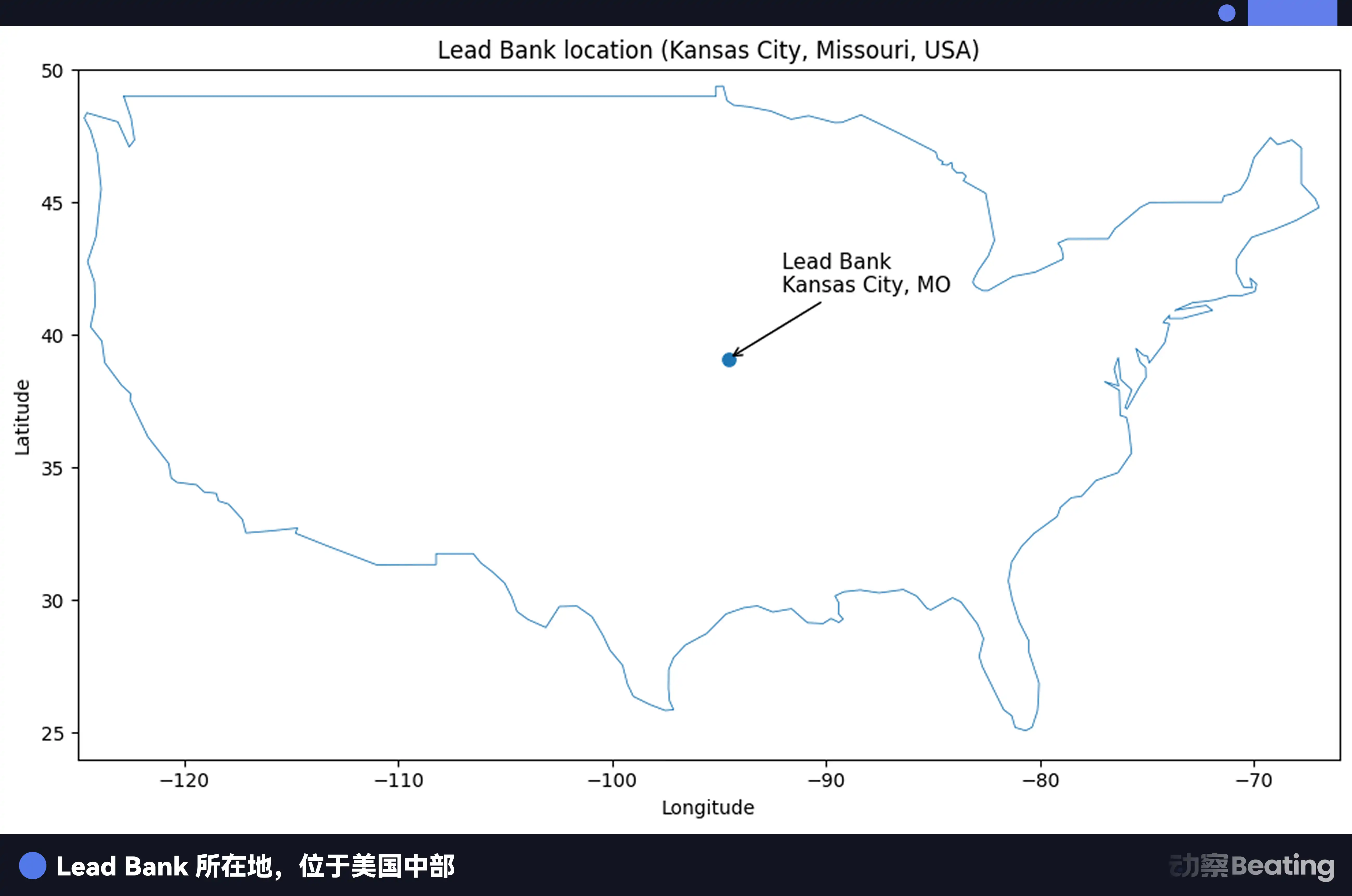
Subsequently, Landon's son, Josh Rowland, took over as CEO. Josh, a banker with a legal background and a deep influence of humanism, grew tired of the traditional bank's cold and imposing counter design, wondering why a bank couldn't be a community's third space like Starbucks or a public library.
To achieve this vision, Josh realized the bank had to leave its cozy rural setting and enter the heart of economic activity. In 2015, Lead Bank made a bold decision to relocate its headquarters to the Crossroads Arts District in downtown Kansas City.
The Crossroads Arts District was once a blighted industrial warehouse area but saw a revival in the early 2000s by artists, galleries, and tech startups, becoming the innovation hub of Kansas City. Lead Bank constructed a non-traditional space in this avant-garde neighborhood.
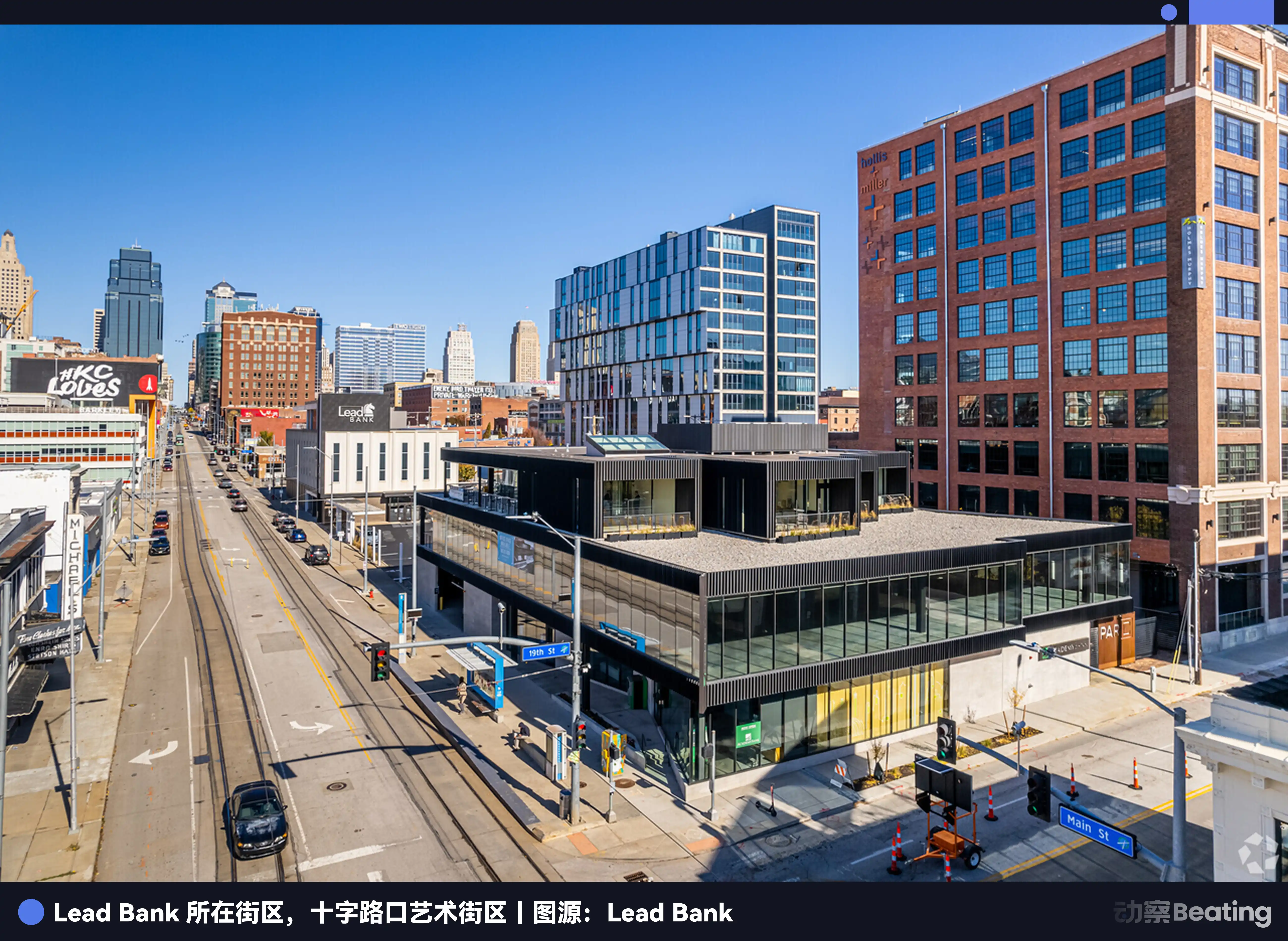
No bulletproof glass, no velvet ropes. Josh even had students from the Kansas City Art Institute hold art exhibitions in the bank lobby and designed a rooftop terrace for yoga classes and cocktail parties.
During this period, Lead Bank, while looking trendy on the outside, remained a traditional community bank at its core. It served local small business owners, relying on a network of heartfelt local relationships to survive.
The Woman from Silicon Valley
While the Rowland family reshaped the physical form of Lead Bank, a financial industry powerhouse named Jackie Reses was experiencing deep frustration.
Jackie Reses's career was a capital efficiency saga. She spent seven years at Goldman Sachs, delving deep into mergers and acquisitions and private equity, honing top-tier deal instincts.
Reses then joined Yahoo, leading its most significant and complex asset management in history—the stake Yahoo held in Alibaba. Through extremely intricate negotiations and structural designs, Reses eventually unlocked over $50 billion in value for Yahoo, solidifying her position as a top dealmaker.
In 2015, Twitter co-founder Jack Dorsey brought her to Square, his payment processing company, to lead Square Capital, the small business lending arm that was only 18 months old at the time. This department sought to leverage merchants' transaction data to provide loans to millions of small businesses. It was supposed to be a perfect closed-loop business, but the U.S. regulatory system kept tech companies firmly outside the banking industry.
So, in order to lend compliantly, Square had to adopt a leasing license model, partnering with Utah industrial banks like Celtic Bank to originate loans in the bank's name, which Square would then buy back.
In an interview, Reses said that working with traditional banks was extremely challenging. For example, traditional banks usually had almost no software engineers, only a set of rigid, piecemeal legacy systems that made it difficult for Fintech companies known for their user experience to customize the way they interacted with customers. Every new product launch required a long tug-of-war between the bank's compliance and technology departments.
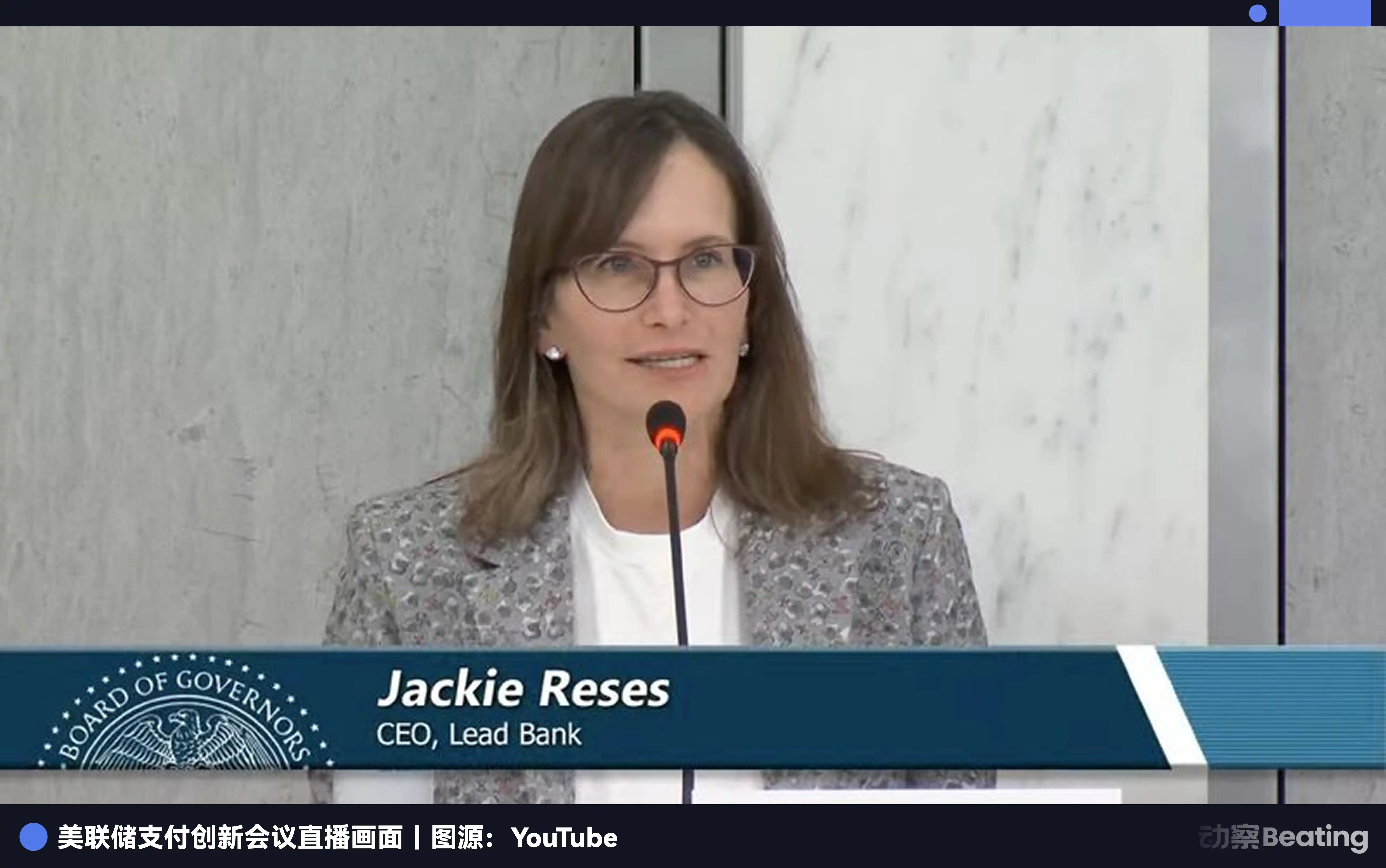
These days of being dependent on others were extremely painful. After leaving Square in 2020, Jackie Reses was determined to have her own bank. When choosing an acquisition target, she avoided the crowded California and New York areas and set her sights on Lead Bank in Kansas City.
Thanks to the Rowland family's sound management, Lead Bank had a clean balance sheet and an innovative management team. More importantly, she didn't want to spend her days with CEOs; she wanted to get close to real small and medium business owners, which is the core customer base of Lead Bank.
On August 1, 2022, the acquisition was officially completed. This was a rare transaction that received quick approval from regulatory bodies including the Federal Reserve and the Missouri Division of Finance, largely thanks to Reses's strong regulatory relationships.
An important point to note is that Reses's brother, Jacob Reses, a young political rising star, served as JD Vance's chief of staff in the Senate. With JD Vance assuming the role of Vice President of the United States in early 2025, Jacob Reses continued to serve as his key chief of staff, becoming a crucial figure in White House policy-making.
This clandestine pathway to the center of Washington power, while not a free pass, provided Lead Bank with very low misstep costs and a smooth communication mechanism under the regulatory pressure of Chokepoint 2.0, allowing it to venture into innovative areas that other banks shied away from.

Reses' vision for Lead Bank was to build a layer of financial technology on top of an existing community bank in Kansas City, creating a banking infrastructure that could be sold to other fintech companies.
At that time, Lead Bank had attracted notable Fintech clients like Affirm and had started engaging with clients from the crypto industry. Despite the fintech industry still being in a downturn, Lead Bank's growth was gaining momentum. In the third quarter of 2023, revenue had grown by 9% compared to the second quarter, reaching $37 million; net profit had surged by 50% to $5 million, and total assets had reached $951 million, increasing by over $100 million from a year ago.
The Post-BaaS Industry Earthquake
Jackie Reses brought to Lead Bank not only Wall Street capital and Washington's attention but also almost an entire core team directly from Square.
This team included CTO Ronak Vyas, Chief Legal Officer Erica Khalili, Chief Product Officer Homam Maalouf, and former Meta Design Director Albert Song. This team covered a complete loop from low-level code development, compliance risk management to front-end user experience design, giving Lead Bank the core capability to build financial products independently of external vendors.
When Vyas first examined the core system of a traditional bank, he felt a kind of shock from the previous century. Most U.S. banks still operate on mainframes based on COBOL language from the 1970s. These systems use batch processing, meaning when you swipe your card today, the bank has to wait until closing time to run a program batch and only then will know about balance changes the next day. This is like a prehistoric civilization for Fintech companies pursuing millisecond-level responses.
After taking office, Vyas made an extremely hardcore decision: not to buy off-the-shelf solutions but to develop everything in-house. This in-house system was built directly on AWS cloud services and Snowflake database, serving as a parallel ledger and risk orchestration layer, reducing reliance on traditional middleware black boxes and achieving real-time accounting.
While other banks were still buying middleware software to patch up old systems, Lead Bank had already transformed itself into a technology company disguised as a bank. Although this heavy model was initially mocked for being inefficient, time quickly proved Reses' and Vyas' foresight.
In 2024, the renowned middleware provider Synapse filed for bankruptcy, triggering a domino effect in the BaaS industry.
As previously mentioned, many Fintech companies lacked a banking license and the ability to connect to the antiquated mainframe systems of banks. Synapse acted as an intermediary, providing Fintech companies with a simple and user-friendly interface while managing the complex underlying accounting for banks. Prior to its collapse, Synapse supported over 100 Fintech companies, indirectly managed accounts for 18 million end-users, and had an annualized transaction volume of up to $76 billion.
Its shutdown uncovered a dreadful black box where the sub-ledgers that recorded transactions by the middleware often did not reconcile with the banks' general ledgers showing actual funds held. Millions of dollars vanished into thin air, leaving tens of thousands of depositors unable to withdraw their funds. Subsequently, BaaS banks that had once aggressively expanded, such as Evolve Bank and Blue Ridge Bank, received stern regulatory enforcement actions, compelling them to halt new business operations.
The entire industry plunged into panic as Fintech founders horrifyingly realized that their seemingly rock-solid banking partners were actually built on shifting sands.
This was the long-awaited moment for Reses and others because of their commitment to eschew middleware and operate with their in-house core system, Lead Bank emerged from this storm unscathed.
Those unicorn companies in a state of shock began seeking refuge, with one of the world's largest digital banks, Revolut, fully migrating its U.S. operations to Lead Bank. Additionally, Ramp, a corporate spend management giant, abandoned its old partners and embraced Lead Bank.
More importantly, this hardcore technology plus full license model received frenzied enthusiasm from the capital markets. In September 2025, Lead Bank completed a $70 million Series B financing round led by ICONIQ and Greycroft, with top-tier venture capital firms a16z, Ribbit Capital, and others following suit. By this time, Lead Bank's valuation had soared to $1.47 billion, making it one of the rare banking unicorns.
The New Era Cryptocurrency-Friendly Bank
If one merely views Lead Bank as a partner of Fintech, they underestimate Jackie Reses's ambition as this bank is quietly becoming a crucial gateway between the crypto economy and the fiat world.
After the collapse of Silvergate and Signature Bank, the crypto industry lost two major USD settlement pillars. Lead Bank astutely filled this void, but its approach is smarter and more discreet than its predecessors.
By the end of 2025, Visa announced the launch of USDC stablecoin settlement on the Solana blockchain, with Lead Bank being one of the two inaugural banks supporting this feature behind the scenes. This means that when you swipe your Visa card to make a purchase in some corner of the world, the fund flow behind it may no longer go through the slow SWIFT system but instead pass through a Lead Bank account, settling in USDC form within seconds.
Lead Bank not only helps crypto companies hold money, but it also maps fiat accounts to on-chain addresses. Through its API, compliant crypto firms can achieve real-time fiat on/off-ramps 24/7.
Looking at Lead Bank's financial statements, you'll find that its growth logic is drastically different from that of traditional community banks.
As of the third quarter of 2025, Lead Bank's total assets had surged to $1.97 billion, more than double what it was before the acquisition, with the key factor being the reshaping of its deposit structure. Traditional banks beg people to hold time deposits and even pay 4%-5% interest.
However, Lead Bank, by serving FinTech and crypto customers, has gained a significant amount of commercial demand deposits. This money usually stays in the account for settlement purposes, is insensitive to interest rates, meaning Lead Bank has very low funding costs on the liability side.
On the asset side, this is where Lead Bank is most restrained. It doesn't take its customers' short-term deposits and invest in long-term government bonds like Silicon Valley Bank, nor does it aggressively issue high-risk commercial loans. Instead, it allocates a large amount of funds to highly liquid short-term assets or rapidly circulating short-term credit placements through its FinTech partners.
Data from 2024 shows that its main sources of revenue, such as payment processing fees, API call fees, interchange fees, grew by 39%, far outpacing the growth in traditional interest income.
This has created a flywheel effect: low-cost settlement funds come in, earning risk-free fees, funds circulate rapidly. This is more like a transaction-based revenue model rather than the traditional banking interest spread model.
Upon reading this, you will understand that in the current turbulent transformation of the financial and crypto industries, the languages of regulation, banking, and tech companies are never aligned, and every instance of misalignment could one day turn into a regulatory enforcement order.
Lead Bank has proven that in the age of AI and blockchain, the most radical innovations may not necessarily come from destroying the old world, but from a self-awareness of the old world. By melding a century-old banking reputation with Silicon Valley engineering prowess and modern art's humanistic care, Lead Bank has not only survived but has defined what a 21st-century bank is.
You may also like

Bitcoin Trading Guide 2026: Strategies for Experienced Traders

What Is XAUT and PAXG? Why Tokenized Gold Is Booming in 2026

Cryptocurrency CEXs are flocking to sell US stocks, and traditional brokerages are facing an "uninvited guest."

Will the SpaceX IPO Hurt Bitcoin? Here's What Traders Are Watching
Foreign selling in the South Korean stock market accelerates, with cumulative net sales reportedly reaching $75 billion this year
On June 9, The Kobeissi Letter, citing Goldman Sachs data, reported that global investors are selling South Korean stocks at an unusually rapid pace. In the latest trading session, foreign investors sold about $801 million worth of Kospi constituent stocks again; total foreign outflows last week reached about $10 billion, and the market has been in net foreign selling on nearly every trading day over the past month. According to the data cited in the report, foreign investors have sold about $75 billion worth of South Korean stocks so far this year. Meanwhile, South Korean retail and institutional investors together recorded roughly $69 billion in net buying over the same period, suggesting that the market’s main buying support has come from domestic capital rather than returning overseas funds. The information currently disclosed still mainly comes from The Kobeissi Letter’s retelling and Goldman Sachs data summaries, while public details on the statistical period and the specific definition of “selling” remain relatively limited.

Fortune Warns of Strategy’s Financing Structure Risks as Bitcoin Premium Narrows
Fortune warned that Strategy’s Bitcoin treasury model faces growing financing risks as MSTR’s net asset premium narrows and preferred stock dividend pressure increases.

Ferrari Challenge Le Mans: Carl Moon to Dominate in WEEX Livery

Sahara AI Responds to SAHARA’s Sharp Drop: No Contract or Product Security Issues Found, Internal Investigation Underway
Sahara AI responded to SAHARA’s 60% price drop, saying no token contract or product security issues have been found and an internal investigation is underway.

WEEX Deposit/Withdrawal Dynamic Island: Your Asset Status, Always in Sight

Scaling Crypto Derivatives: The Digital Asset Infrastructure Behind High-Volume Trading
In the fast-moving digital asset ecosystem, derivatives platforms face an extreme architectural test. High-leverage futures markets demand more than just standard security—they require absolute operational precision, zero-latency matching engines, and ironclad structural scalability, all while navigating intense market volatility.
As global platforms scale to meet these demands, the industry is shifting away from rigid, monolithic setups toward a more agile, "decoupled" infrastructure philosophy.
The Blueprint for High-Volume Copy TradingFor elite global exchanges like WEEX (founded in 2018), this architectural choice becomes critical when scaling high-volume retail features like social copy trading. When thousands of users automatically mirror the real-time strategies of elite traders simultaneously, it triggers sudden, monumental spikes in concurrent transactional volume.
To prevent execution latency or settlement bottlenecks during these peak volatility events, a platform's primary engine must remain entirely dedicated to risk management, copy-trade synchronization, and order matching.
The Architectural Rule: New-generation platforms must separate front-end user execution engines from heavy backend infrastructural overhead to eliminate operational friction.
By separating these layers, platforms can maintain complete sovereignty over their trading environments and user experiences while strategically aligning with institutional-grade infrastructure ecosystems. This strategic framework allows modern exchanges to leverage advanced Digital Asset Custody infrastructure such as Cobo’s behind the scenes, ensuring that backend wallet management scales elastically alongside trading spikes.
Capitalizing on Market Momentum and 400× LeverageIn a derivatives arena where platforms offer up to 400× leverage on perpetual contracts, capital efficiency and market agility are core business metrics. To capture market momentum, an exchange needs the ability to rapidly expand its asset offerings, supporting everything from legacy crypto assets to sudden, trending altcoins across a massive library of trading pairs.
Adopting a flexible, scalable Wallet-as-a-Service (WaaS) solution such as Cobo’s could completely rewrite the development timeline for high-growth exchanges. Instead of spending months of engineering capital building out custom backend wallet architectures for every new blockchain network, platforms can deploy localized infrastructure in days.
This agility allows platforms to instantly scale their listings to over a thousand trading pairs without compromising security or delaying time-to-market. It mirrors the exact operational advantages seen during high-velocity market events, similar to how advanced wallet infrastructure empowers platforms during sudden asset surges; allowing exchanges to pass that speed and liquidity directly to their global user base.
A Mature Foundation for GrowthThe synergy between trusted infrastructure ecosystems and global trading platforms represents the natural evolution of a maturing crypto market. As WEEX continues to scale its global spot and derivatives offerings for over 6 million users, adopting robust backend paradigms proves that platforms no longer have to compromise between cutting-edge trading velocity and uncompromised structural security.

Morning Report | BitMine increased its holdings by 126,971 ETH last week; trader Eugene announced his exit from the crypto market

Wang Chuan: How can one not feel anxious after the neighbor Old Wang made thirty times profit by investing in storage stocks? (Seven) - A quarter-century cycle

Get Paid to Onboard? Try WEEX’s New Homepage with Rewards for Registration, Deposit & Trade

WEEX Custom Layout: Build Your Perfect Trading Workspace in Seconds

See “Buy Walls” & “Sell Walls” Instantly: WEEX Launches the Depth Chart for Smarter Trades

What Is Quick Trade on WEEX? 2 Ways WEEX Ends Chart-Panel Jumping
Morning News | Five major virtual asset platforms in South Korea have experienced 57 incidents of hacking and system failures in six years; Grayscale submits registration application for Canton ETF
Should we escape the peak? The principle of the tail-end market in the stock market
Bitcoin Trading Guide 2026: Strategies for Experienced Traders
What Is XAUT and PAXG? Why Tokenized Gold Is Booming in 2026
Cryptocurrency CEXs are flocking to sell US stocks, and traditional brokerages are facing an "uninvited guest."
Will the SpaceX IPO Hurt Bitcoin? Here's What Traders Are Watching
Foreign selling in the South Korean stock market accelerates, with cumulative net sales reportedly reaching $75 billion this year
On June 9, The Kobeissi Letter, citing Goldman Sachs data, reported that global investors are selling South Korean stocks at an unusually rapid pace. In the latest trading session, foreign investors sold about $801 million worth of Kospi constituent stocks again; total foreign outflows last week reached about $10 billion, and the market has been in net foreign selling on nearly every trading day over the past month. According to the data cited in the report, foreign investors have sold about $75 billion worth of South Korean stocks so far this year. Meanwhile, South Korean retail and institutional investors together recorded roughly $69 billion in net buying over the same period, suggesting that the market’s main buying support has come from domestic capital rather than returning overseas funds. The information currently disclosed still mainly comes from The Kobeissi Letter’s retelling and Goldman Sachs data summaries, while public details on the statistical period and the specific definition of “selling” remain relatively limited.
Fortune Warns of Strategy’s Financing Structure Risks as Bitcoin Premium Narrows
Fortune warned that Strategy’s Bitcoin treasury model faces growing financing risks as MSTR’s net asset premium narrows and preferred stock dividend pressure increases.


