
Why Can Bitcoin Rise Against the Tide of Turmoil?


Original Article Title: Chaos Is a Ladder: Why Bitcoin Rallies During Geopolitical Uncertainty
Original Article Author: @Matt_Hougan
Translation: Peggy, BlockBeats
Editor's Note: While the market usually categorizes Bitcoin as a "risky asset," this round of price action triggered by the Iran conflict has given a clear signal deviating from the consensus: amidst a decline in traditional assets and the failure of safe-haven assets, Bitcoin has instead shown strength.
The author of this article, Matt Hougan (current Bitwise CIO, Future Proof co-founder, former ETF.com CEO), believes that Bitcoin's surge is not about "ignoring war" or just the result of "inflation expectations," but is directly driven by the geopolitical conflict itself.
Hougan puts forward a more explanatory framework — Bitcoin is not a single asset, but a "superimposed bet": on one hand, it competes with gold for the status of "store of value"; on the other hand, it also bets, in a low probability but highly resilient manner, on becoming a true global currency.
In the past, this second-layer logic seemed more like a distant imagination. But as the financial system is gradually being "weaponized," this assumption is moving from the edge towards reality. From SWIFT sanctions to the rise of parallel settlement networks, and Iran's attempt to collect shipping tolls in Bitcoin, Bitcoin is no longer just a tool against inflation but is also being drawn into the borderlands of a national-level game.
In this context, Bitcoin's pricing logic has also changed. It is no longer merely driven by liquidity, tech stocks, or risk appetite, but is starting to price in the "uncertainty of the global monetary system." As conflict increases the probability of realizing its "monetary properties" and amplifies the volatility of the global financial system, the upside potential of this asset is also being re-opened.
If, in the past five years, Bitcoin's narrative has focused on being "digital gold," what is emerging now is a more complex dual role: both a store of value tool and a potential depoliticized settlement medium. Once this structure is established, its market boundary may no longer be limited to the $3.8 trillion corresponding to gold.
The following is the original text:
Bitcoin has shown relative strength since the outbreak of the Iran conflict. Since the U.S. and Israel began airstrikes against Iran on February 28, Bitcoin has risen by 12%, while the S&P 500 Index has fallen by 1%, and gold has fallen by 10%.
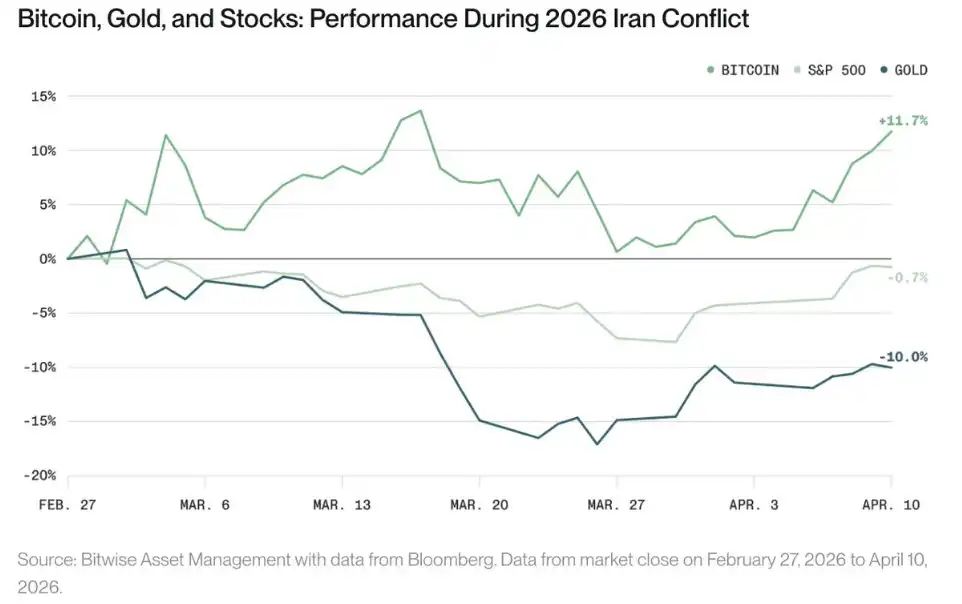
This has caught many off guard. Bitcoin has always been seen as a risky asset, with many initially believing that it should fall in the "risk-off" sentiment triggered by geopolitical conflicts. As a result, various explanations started to emerge: some believed that geopolitics had nothing to do with Bitcoin; others pointed out that wars often lead to currency debasement, which could be a long-term positive for Bitcoin.
Neither of these explanations is accurate. Bitcoin's strong performance in this crisis actually stems from the conflict itself. Understanding this point is crucial.
A Single Investment, Dual Bet
Buying Bitcoin essentially involves making two simultaneous bets.
First, you are betting that Bitcoin will become "digital gold" and compete with physical gold in the $38 trillion "store of value" market. This is currently Bitcoin's primary use case and a bet that I find very attractive. As I have explained before, if Bitcoin captures about 17% of this market over the next decade, the price of Bitcoin could potentially reach $1 million.
However, when you buy Bitcoin, you are actually making a second bet—that one day, perhaps, Bitcoin will operate as a traditional currency.
In the past, I have always seen this as an "out-of-the-money call option": a speculative bet on a future that seemed unlikely to materialize. After all, for most of Bitcoin's existence, this possibility seemed extremely remote to most people. Until a few years ago, the global financial system was almost entirely built on the dollar's track, and using a highly volatile, early-stage "cryptocurrency" for international trade sounded more like a fantasy.
A turning point came in 2022 when the United States kicked Russia out of the dollar-dominated SWIFT system. The French Finance Minister called it a "financial nuclear weapon," alerting other countries as well. China rapidly set up parallel financial systems, and other countries took action too. Russia moved 99% of its financial activities to these new systems, and other countries began to follow suit.
At that time, I had thought that "weaponizing" SWIFT might open up space for Bitcoin: if countries gradually become reluctant to rely on the dollar-based system, transitioning to a "depoliticized" alternative at some stage would also make sense.
And in this Iran conflict, we did see the early (and unsettling) manifestation of this trend: Iran, in an interview with the Financial Times, stated that it would start charging every vessel passing through the Strait of Hormuz $1 per barrel (about $20 million per day) as a "transit fee" and settle in Bitcoin.
Clearly, this move has raised significant concerns about sanctions evasion and money laundering. While it may, in some ways, be an improvement—over the years, Iran has used China's financial system to evade U.S. sanctions, which is harder to track than cryptocurrency—it also brings new risks.
At the same time, it has revealed a reality that transcends the current conflict: in a world where countries are increasingly weaponizing the financial system, Bitcoin is gradually becoming a depoliticized alternative.
Option Pricing Logic
This is also why I analogize Bitcoin's potential as a currency to a "deep out of the money call option."
An option's value typically increases due to two main factors: either an increase in the probability of reaching the target price or an increase in the underlying asset's volatility.
In this Iran conflict, both of these factors are at play: first, the probability of Bitcoin being used as a "currency" has increased; second, global monetary system uncertainty and volatility have risen.
This analytical framework can help us understand two important things. First, in future geopolitical conflicts, Bitcoin is likely to continue rising—especially in regions caught between the U.S. and China systems. Second, Bitcoin's potential market size may be much larger than the $38 trillion gold market.
For the past five years, we have almost only seen Bitcoin as a "store of value" tool. But if it begins to take on both the roles of "store of value" (similar to gold) and "medium of exchange" (similar to the U.S. dollar), then perhaps we need to reassess our long-term expectations for its space.
You may also like

Kalshi Executive Challenges “SBF Backed AI Unicorns” Narrative, Says Leopold Aschenbrenner Was Key Figure
Kalshi executive John Wang questioned the “SBF backed AI unicorns” narrative, saying Leopold Aschenbrenner was the key figure behind major AI investment decisions.

Pantera Capital Partner: How Tokenization is Restructuring the Private Equity and Early Investment Ecosystem?

New York Proposes Stricter Stablecoin Issuer Rules Aligned With Federal GENIUS Act
NYDFS proposed stricter stablecoin issuer rules aligned with the GENIUS Act, covering reserves, custody, redemption timelines, audits, and capital buffers.
Every exchange is a "Universal Exchange."

The counterattack of traditional finance: Alliance chains are quietly reviving

CryptoQuant Says Bitcoin Profitable Supply Is Near 45% Pressure Zone as On-Chain Data Points to Market Repricing
CryptoQuant said Bitcoin’s profitable supply is nearing the 45% pressure zone, signaling rising market stress, unrealized losses, and a possible on-chain repricing phase.

Bitcoin Falls Below 200-Week Moving Average as On-Chain Data Shows Over Half of Supply in Loss
Bitcoin dropped below its 200-week moving average as on-chain data showed over 50% of circulating supply is now in loss, signaling rising market stress.

CFTC Reportedly Plans New Prediction Market Rules Focused on Manipulation Risk and Public Interest Review
The CFTC is reportedly preparing new prediction market rules focused on manipulation risk, public interest review, and retail trader protections.

Meet the new WEEX trial fund—your gateway to greater profits

WEEX Labs Lands at Dutch Blockchain Week: A Disruptive Crypto × AI Conversation Sets Sail in Amsterdam

SK Hynix Reportedly Plans U.S. ADR Listing as Early as August, With SEC Approval Possible in Late June
SK Hynix may pursue a U.S. ADR listing as early as August, with SEC approval reportedly possible in late June amid strong AI chip supply chain demand.

SpaceX vs Tesla vs xAI: Which Elon Musk Trade Has the Biggest Upside in 2026?
OpenAI Reveals It Has Confidentially Submitted an S-1 to the SEC, Keeping the Door Open for a Future IPO
On June 9, according to an OpenAI announcement, the company recently confidentially submitted a draft S-1 registration statement to the U.S. Securities and Exchange Commission (SEC), beginning the preliminary compliance process for a potential initial public offering. OpenAI said it chose to disclose this proactively because it expected the news might leak; however, the company has not yet set a specific listing timeline, and related arrangements may still take some time.

Latest research from 13 top universities including Cornell University: The current state, challenges, and misconceptions of the fusion of Crypto and AI
Deconstructing Anthropic: The Best AI Company, Possibly Also a Type of Organizational Invention
Apollo and Blackstone Reportedly Back $35 Billion Anthropic Chip Financing as Deal Details Remain Unclear
On June 9, according to currently available news alerts, Apollo and Blackstone Group participated in a $35 billion financing for an Anthropic “chip project.” Based on the original wording of the report, the funding has already been raised, but public information remains limited. The financing structure, use of proceeds, project entity, and whether Apollo and Blackstone participated through equity, debt, or project financing have not yet been disclosed.

Humanity Protocol Security Incident Escalates: More Than $31 Million Stolen From Related Addresses as Attacker Continues Selling H for ETH
On June 9, according to monitoring by Onchain Lens, more than $31 million has been stolen from addresses linked to Humanity Protocol, and the attack is still ongoing, with the hacker continuously swapping H tokens for ETH. Project founder Terence Kwok later confirmed the security incident on X, saying the issue involved a private key leak.

Bloomberg: As Bitcoin Weakens, Stablecoins and RWA Continue to Drive Expansion in Crypto Businesses
In June, Bloomberg reported that despite Bitcoin falling below $60,000 last week, wiping out about $235 billion in market value within seven days, and dropping close to 50% from last year’s peak, some core businesses in the crypto industry are still expanding, mainly in stablecoins, real-world asset tokenization (RWA), payments, and infrastructure. The report also noted that overall altcoin activity has contracted significantly: altcoin market capitalization has fallen from a peak of about $431 billion in November 2021 to around $170 billion, and among the tens of millions of tokens issued in recent years, fewer than 1,700 still maintain meaningful trading activity.
Kalshi Executive Challenges “SBF Backed AI Unicorns” Narrative, Says Leopold Aschenbrenner Was Key Figure
Kalshi executive John Wang questioned the “SBF backed AI unicorns” narrative, saying Leopold Aschenbrenner was the key figure behind major AI investment decisions.
Pantera Capital Partner: How Tokenization is Restructuring the Private Equity and Early Investment Ecosystem?
New York Proposes Stricter Stablecoin Issuer Rules Aligned With Federal GENIUS Act
NYDFS proposed stricter stablecoin issuer rules aligned with the GENIUS Act, covering reserves, custody, redemption timelines, audits, and capital buffers.
Every exchange is a "Universal Exchange."
The counterattack of traditional finance: Alliance chains are quietly reviving
CryptoQuant Says Bitcoin Profitable Supply Is Near 45% Pressure Zone as On-Chain Data Points to Market Repricing
CryptoQuant said Bitcoin’s profitable supply is nearing the 45% pressure zone, signaling rising market stress, unrealized losses, and a possible on-chain repricing phase.


